
 Huanghua Group Co., Ltd.









Circuit Breaker Testing with a Multimeter: Scope and Limits
A multimeter can help check electrical continuity in an appropriately isolated circuit breaker, but it cannot establish the breaker’s complete protective performance. A continuity indication does not prove the trip curve, fault-interrupting capacity, insulation performance or suitability for continued service.
If you are searching for how to test a circuit breaker with a multimeter, the first decision is which question needs answering. Checking whether contacts conduct is different from proving that a breaker trips correctly. This guide explains the scope and interpretation of those checks without treating an open electrical panel as a DIY test bench.
Start with the fault report
“The breaker is bad” is a conclusion, not an observation. Useful observations include failure to latch, loss of supply, repeated operation, visible damage, unusual heat or a recorded protection alarm. Each can have causes outside the breaker itself.
Record the exact device reference, circuit, operating condition and event history. For an electronic trip unit, preserve the trip indication or event record before it is lost. For a motor or converter circuit, note whether the problem occurs at starting, during steady operation or after a recent modification.
What a continuity function actually measures
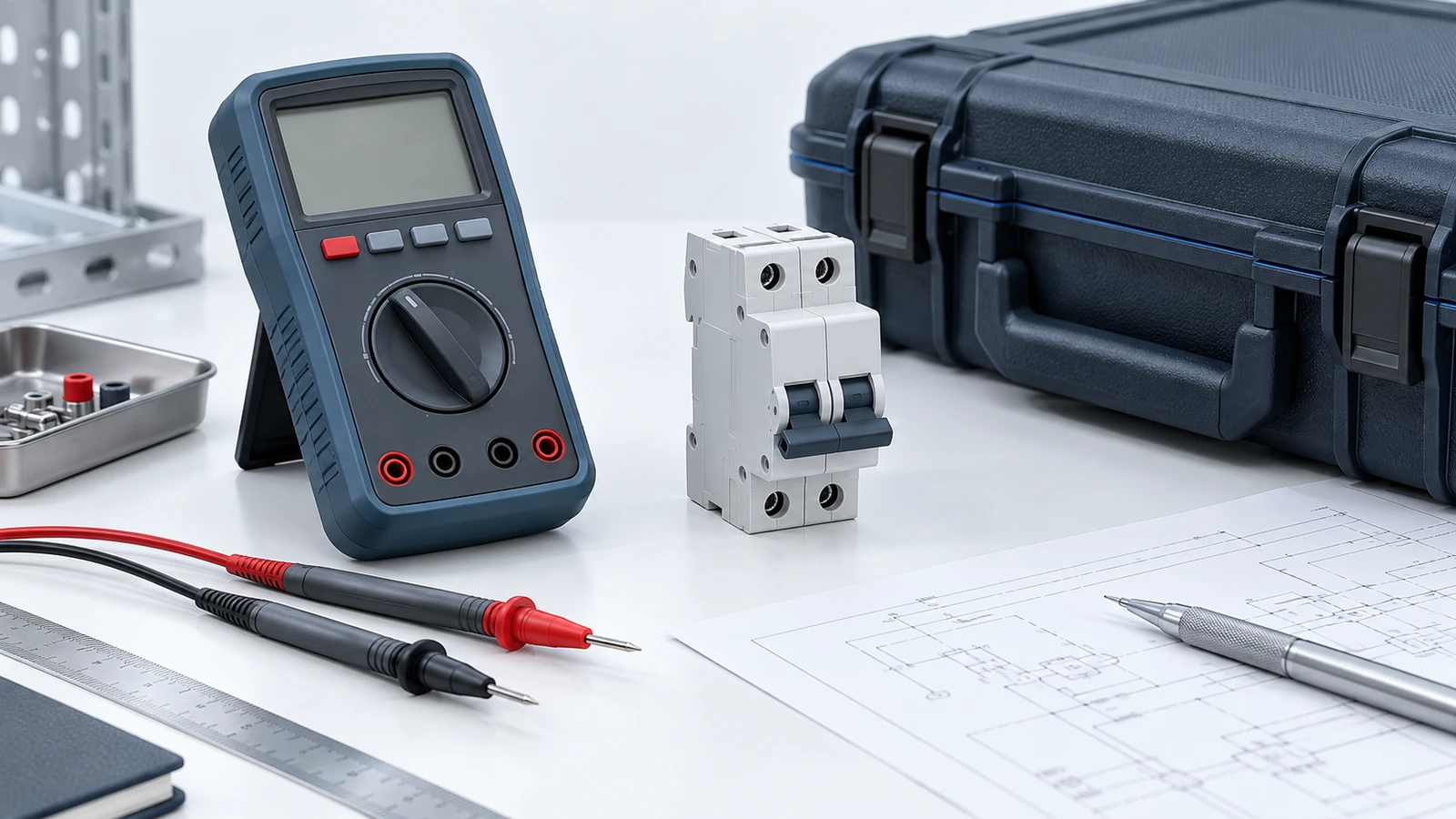
A digital multimeter’s continuity function applies a small test current and evaluates the resulting resistance. A buzzer generally indicates that the measured value falls below the instrument’s threshold. That threshold is instrument-dependent; the sound is not a precision contact-resistance result.
Fluke explains this distinction in its continuity guidance. A low-current test can identify a conductive path, but the path may include something other than the contact being investigated if the device remains connected to parallel circuitry. The isolation and connection arrangement therefore affects the meaning of the result.
Continuity and resistance modes must not be applied to energized equipment. In the US workplace context, OSHA requires appropriate deenergization procedures and verification by a qualified person, including consideration of backfeed. A handle in the OFF position does not establish that every accessible part in a panel is safe.
Interpreting an isolated contact-path check
| Observation | Possible interpretation | What it does not prove |
|---|---|---|
| Conductive path with contacts intended closed | The tested path conducts at the meter’s test conditions | Low resistance under load or correct protection behavior |
| No conductive path with contacts intended closed | Possible contact, mechanism, connection or test-arrangement issue | The root cause without further investigation |
| Conductive path with contacts intended open | Possible parallel path, incorrect test points or equipment defect | That the breaker alone is responsible |
| Different observations between poles | A reason to investigate the device and test setup | A universal pass/fail value applicable to all breaker types |
Use the selected breaker’s manual to determine whether a particular continuity check is appropriate and how results should be recorded. Do not extrapolate a procedure for a drawout power breaker to a sealed miniature breaker, or vice versa.
Why a normal reading can miss a problem
A meter uses very different conditions from a loaded circuit. A connection may conduct a small test current yet show unacceptable heating or voltage drop in service. A contact can also have a condition that requires a low-resistance instrument and a defined test method to assess meaningfully.
Similarly, a breaker with apparently normal continuity may have an issue in its trip unit, sensing path, mechanism or accessories. A shunt release, undervoltage release and overcurrent trip system have different functions. A successful test of one does not certify the others.
Insulation resistance is another separate measurement. It uses a different instrument and test conditions, and sensitive electronics may require specific treatment. Do not substitute an insulation tester for a multimeter without consulting the applicable equipment instructions.
Trip verification needs a defined test method
Manufacturer-approved electronic test equipment can exercise specified trip-unit functions. Primary-injection testing can assess a broader current-sensing and tripping path under the stated test arrangement. The correct scope depends on the device, acceptance requirements and purpose of the work.
Schneider Electric’s MicroLogic technical literature explicitly distinguishes trip-unit testing with a test kit from primary-injection verification of the circuit breaker and trip unit. That distinction is a useful example, not a universal instruction for every manufacturer’s product.
Acceptance criteria must come from the relevant documentation and test plan. A reading copied from another breaker’s service report is not a justified threshold. Record ambient conditions, settings, device identity, instruments and the actual procedure so that the result can be interpreted later.
When to stop testing and escalate
Visible burning, cracked cases, damaged terminals, water exposure, mechanical failure or evidence of a significant fault warrants manufacturer or qualified maintenance assessment. Avoid repeated energization to see whether the device “holds this time.” A protective operation is an event to investigate, not a challenge to defeat.
For industrial installations, the site acceptance testing guide explains why approved test plans and traceable records matter. A useful report identifies what was verified and what remains outside the test scope.
Questions about multimeter testing
Does a continuity beep mean the breaker is good?
No. It indicates a conductive path under the instrument’s test conditions. It does not prove trip performance or short-circuit capability.
Can a multimeter measure the breaker’s trip current?
A normal multimeter alone does not generate and control the test current needed to verify a trip characteristic. That requires suitable test equipment and a defined procedure.
Should a repeatedly tripping breaker be replaced immediately?
First establish the cause through qualified investigation. Overload, wiring faults, equipment faults, settings and application issues can remain even after replacement.