
 Huanghua Group Co., Ltd.

Aluminum and Stainless Steel Galvanic Corrosion: Interfaces and Prevention
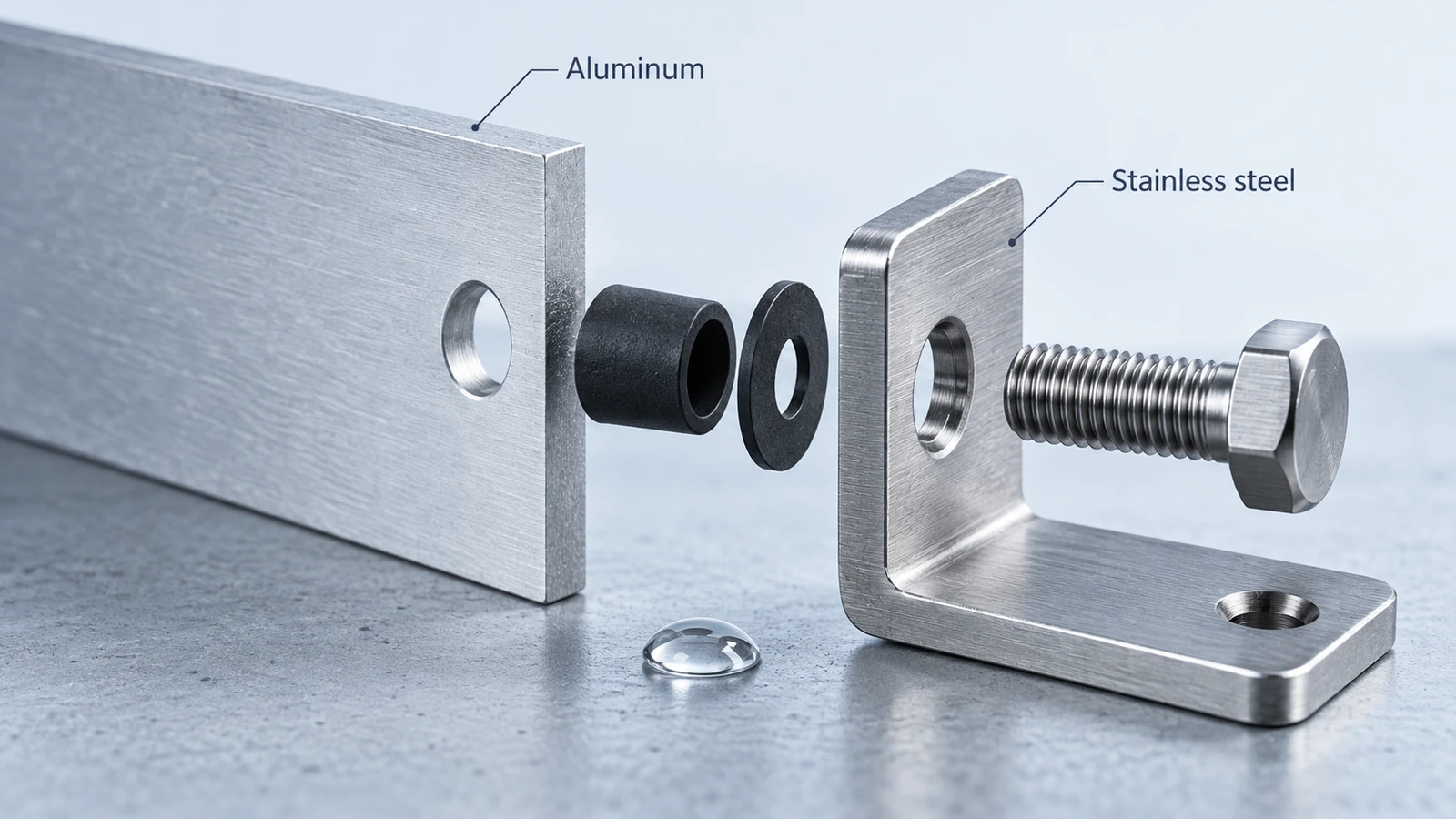
Aluminum and stainless steel can form a galvanic-corrosion couple when they are electrically connected and bridged by a conductive liquid. Aluminum is generally the more vulnerable member of this pairing. The severity depends on the environment, exposed areas, joint design and surface condition—not simply whether the two metals touch.
In electrical enclosures and outdoor assemblies, the practical question is how the complete interface behaves over its service life. A stainless fastener can be useful, but its corrosion resistance does not automatically protect the aluminum around it.
Three conditions create the galvanic cell
The British Stainless Steel Association identifies the key combination: dissimilar materials, electrical contact and an electrically conductive liquid. Moisture containing salts can be more aggressive than a comparatively clean, occasionally wet environment. If the interface remains dry, the electrochemical corrosion cell is not operating in the same way.
A design review should therefore look beyond the material names. Ask where water can collect, how it drains, whether salts can accumulate and whether coatings or barriers remain intact at edges and fasteners.
Relative exposed area changes the risk
A small anodic area coupled to a much larger cathodic area can suffer more concentrated attack. In an aluminum–stainless pairing, that makes a small aluminum component attached to a large stainless surface a different case from a small stainless fastener in a broad aluminum panel.
The BSSA discusses this area effect and also gives examples showing that environment can change the outcome. Do not turn the general area principle into a blanket promise that stainless bolts in aluminum are always safe. Trapped saltwater, damaged finishes and crevices can still create local problems.
| Interface question | Why it matters |
|---|---|
| How much of each metal is wetted? | The relevant exposed areas affect the corrosion couple |
| Can water remain around the joint? | Persistent wetting can sustain the electrolyte path |
| Are cut edges or holes unprotected? | Small damaged areas can become concentrated attack sites |
| Will maintenance disturb the barrier? | A protective detail must survive assembly and service |
Design the joint before choosing a washer
Insulating washers, sleeves or gaskets can reduce electrical contact between dissimilar metals when properly designed. A washer on one face alone may leave another metal-to-metal path through the fastener shank, a bracket or an adjacent part. Review the whole connection.
Where an insulating detail is appropriate, specify its geometry, material, environmental suitability and assembly method. Include how compression, vibration, temperature and service access affect it. A barrier that cracks during tightening or is omitted during maintenance cannot perform its intended role.
However, electrical equipment may also require protective bonding. Do not casually isolate a metal panel or mounting point that forms part of the required protective path. Corrosion control and electrical safety must be coordinated: the design may need a separate approved bonding connection and a deliberately protected mechanical interface.
Reduce wetting and protect vulnerable surfaces
Drainage, avoidance of water traps and suitable joint geometry can reduce exposure. Coatings and sealants may help, but their suitability depends on materials, preparation, application and long-term condition. They are not interchangeable with a complete joint design.
Consider the order of fabrication and finishing. Drilling or cutting after a finish is applied can expose new material at a critical interface. If post-finish work is necessary, define the treatment and inspection of those areas. Also specify how damaged coatings are repaired during assembly or service.
A narrow surface defect can be more important than a large intact coated area. The design review should identify where defects are most likely—fastener holes, panel edges, sliding interfaces and removable covers—rather than assuming a nominal coating description resolves every joint.
An outdoor-enclosure review example
Consider an illustrative aluminum enclosure mounted on stainless brackets near a coastal site. The initial specification names the metals but says nothing about drainage or the fixing detail. During review, the team identifies a horizontal ledge where saltwater could remain around the fasteners.
A stronger specification records the environment, revises the water-trapping geometry, defines the interface barrier where appropriate, preserves the required bonding path and adds inspection points for cut edges and barrier installation. These are proposed design actions, not a claim that one standard detail will suit every enclosure.
The acceptance package should include the approved joint drawing and evidence that the delivered assembly matches it. “Stainless hardware supplied” would not prove that the corrosion-control detail was implemented.
What to put in the supplier enquiry
- Environment: indoor or outdoor exposure, moisture, marine salts, washdown and relevant chemicals.
- Materials: actual aluminum and stainless grades, finishes and any intermediate materials.
- Joint detail: fastener, sleeve, washer, gasket, drainage and sealing arrangement.
- Electrical function: required bonding or conductive interfaces and how they are verified.
- Inspection: coating damage, edge treatment, omitted barriers and assembly records.
- Maintenance: replacement parts, repair method and inspection access.
For equipment containing aluminum conductors, keep the conductor-termination question separate from enclosure corrosion. The aluminum conductivity guide explains why electrical material selection requires more than a corrosion comparison.
Common questions
Can aluminum and stainless steel touch?
They can be used together in an engineered design. Assess moisture, environment, relative area and the joint detail rather than giving an unconditional yes or no.
Does stainless steel prevent corrosion of the aluminum?
No. Its own corrosion resistance does not remove the galvanic risk to a connected aluminum component.
Is a salt-spray test enough to predict service life?
Do not equate one test result with a universal service-life forecast. Define the purpose and acceptance criteria of any test, and relate them to the actual materials, geometry and environment.