
 Huanghua Group Co., Ltd.









What Is the Melting Point of Copper? Grades, Alloys and Process Context
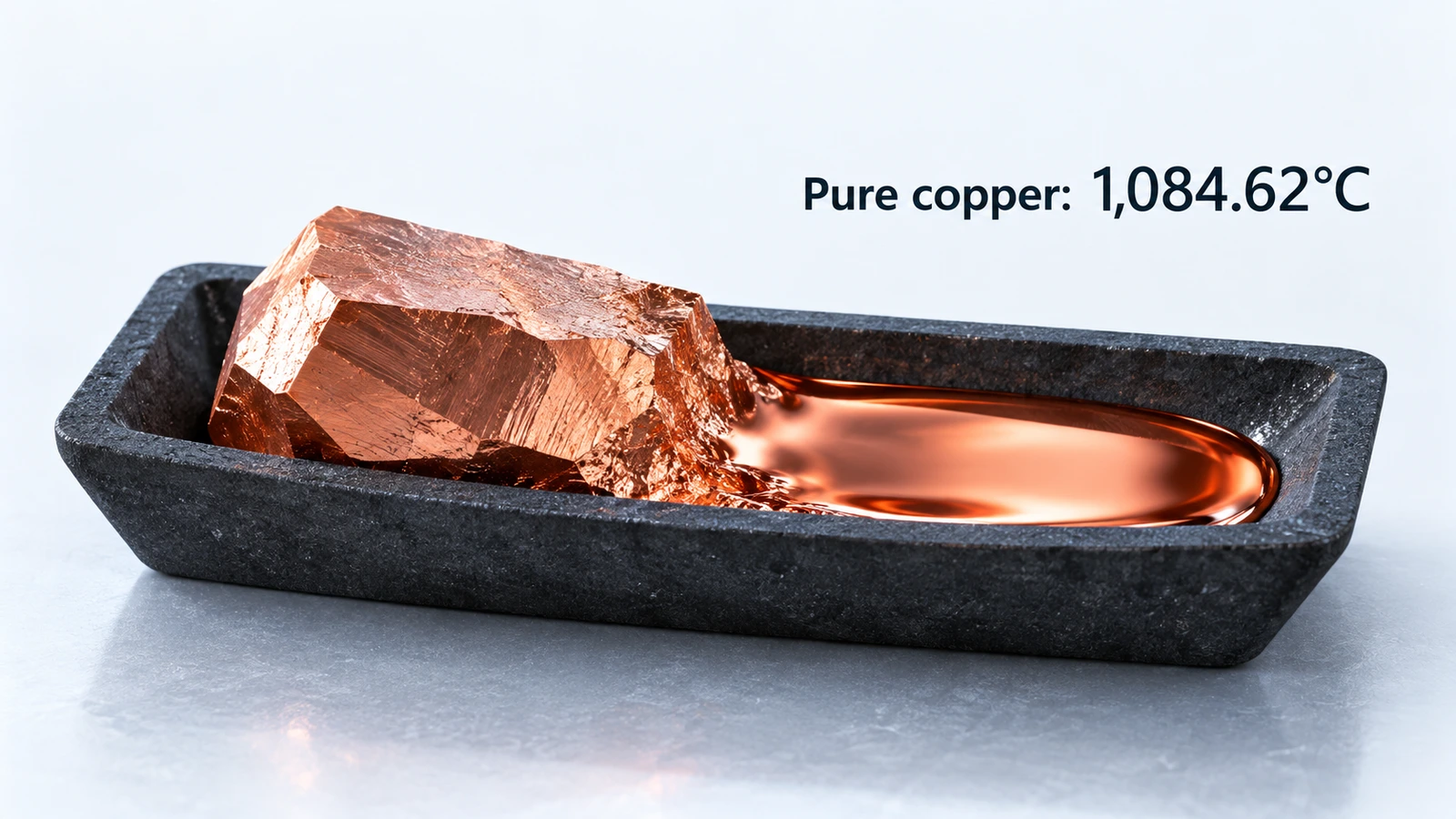
The Royal Society of Chemistry lists copper’s melting point as 1,084.62°C, equivalent to 1,984.32°F or 1,357.77 K. That is a reference property for the element. It is not an operating-temperature rating for a copper cable, busbar, winding or complete electrical assembly.
The distinction is especially important when a material question becomes a manufacturing or equipment-selection question. Pure copper, a specified commercial copper grade, a brass fitting and a copper joint can require different thermal information.
Temperature and unit reference
| Temperature scale | Reference melting point | Use |
|---|---|---|
| Celsius | 1,084.62°C | Common engineering material reference |
| Fahrenheit | 1,984.32°F | Equivalent value for documents using °F |
| Kelvin | 1,357.77 K | Absolute-temperature representation |
The conversions use °F = (°C × 9/5) + 32 and K = °C + 273.15. Rounding to about 1,085°C can be appropriate for a general explanation, but a process specification should identify the material grade and the actual data basis rather than rely on a rounded internet value.
Pure copper versus copper alloys
Brass, bronze and other copper alloys are not pure copper. Their compositions affect thermal behavior. Alloy data may identify a solidus and liquidus rather than a single melting temperature. Below the solidus the material is solid; above the liquidus it is liquid; between them, solid and liquid phases can coexist.
The Copper Development Association publishes grade-specific melting-range information for wrought copper alloys. That is why a workshop should not assign pure copper’s reference melting point to every copper-colored part.
A purchasing document should identify the alloy designation and material condition. If a substitution is proposed, compare the properties relevant to the process and final product. A similar appearance or a supplier’s description of “high copper content” is not enough to establish equivalent thermal behavior.
Melting is not the first thermal change that matters
Electrical equipment can become unsuitable for service long before its copper conductor melts. Insulation, terminal interfaces, adjacent materials and mechanical properties can have much lower limits. Heating can also affect contact performance and the condition of a conductor or joint.
Therefore, a claim such as “the copper does not melt until over 1,000°C, so this temperature is safe” is not a valid equipment assessment. The complete construction, intended duty and relevant product requirements determine the allowable temperature conditions.
A conductor’s temperature rise and its absolute temperature are also different quantities. An equipment report should make clear which is being stated and under what ambient and loading conditions. The element’s melting point does not establish either permissible value.
Why a furnace setting is not the melting-point number
A material property describes the material. A manufacturing process must also account for heat transfer, charge size, equipment, atmosphere, measurement location and the required process result. The temperature indicated by a furnace controller is not automatically the temperature of every part of the charge.
Casting or other thermal processes require an approved method for the actual grade and equipment. Do not convert the reference melting point into a furnace instruction by adding an arbitrary margin. Process development should define the material, controls, measurement and acceptance evidence.
The same applies to joining. Soldering and brazing involve filler materials and joint procedures; welding has different process requirements. The filler’s melting behavior is not the same as that of the copper base material. A general article cannot select a joining temperature solely from the element’s property table.
Reading a material data sheet
| Field | Question to ask |
|---|---|
| Grade and composition | Is the data for the material actually being purchased? |
| Melting point or range | Is it an elemental reference, solidus, liquidus or a broad typical range? |
| Condition | Does the supplied condition match the forming or joining process? |
| Property basis | Are values typical information or contractual acceptance requirements? |
| Traceability | Can the batch and supporting certificate be tied to the part? |
For a critical component, agree which properties need verification and which evidence is acceptable. Avoid asking for a generic “copper certificate” without stating the grade, standard, required properties and batch identification.
An electrical-component example
Consider an illustrative enclosure assembly containing a copper busbar, insulated cables, terminal hardware and polymer supports. The busbar’s elemental melting point tells you very little about the assembly’s permissible loading. The connections, spacing, insulation, support materials and thermal design all require their own assessment.
If a joint shows discoloration or localized heating, the investigation should address connection condition, load, contact resistance and the assembly design. Reassurance that the copper remains solid does not resolve the fault.
For transformer windings, winding resistance testing concerns a different property and test purpose. Material thermal data and electrical test results should be interpreted within their own scopes.
Common questions
Is copper’s melting point exactly 1,085°C?
That is a rounded value. The RSC reference is 1,084.62°C. Use the actual grade-specific basis when the number affects a process specification.
Does brass melt at the same temperature as copper?
Do not assume so. Brass is an alloy family with composition-dependent properties. Consult the specific alloy’s data.
Can copper carry current safely up to its melting point?
No. Equipment temperature limits are governed by the complete construction and applicable requirements, far beyond whether the conductor remains solid.