
 Huanghua Group Co., Ltd.
Is Copper a Magnetic Material? Conductors, Cores and Material Checks
Pure copper is not ferromagnetic. It is diamagnetic, meaning its response to an applied magnetic field is weak and repulsive rather than the strong attraction associated with iron. In everyday language, copper is usually called non-magnetic. That description does not mean copper cannot interact with a changing magnetic field.
The distinction helps explain three common observations: a stationary magnet does not normally stick to a clean copper piece, a moving magnet can experience resistance near copper, and a copper-colored component can still be strongly attracted to a magnet. These observations involve different mechanisms or different materials.
Non-magnetic does not mean no magnetic response
The Copper Development Association identifies copper’s magnetic state as diamagnetic. A diamagnetic response is much weaker than the familiar attraction of a ferromagnetic material. A hand-held magnet test is therefore a rough screening observation, not a quantitative measurement of magnetic properties.
In engineering documents, replace a vague “non-magnetic” requirement with the property and acceptance method that actually matter. A requirement concerning magnetic permeability is different from a requirement concerning electrical conductivity, corrosion resistance or mechanical strength.
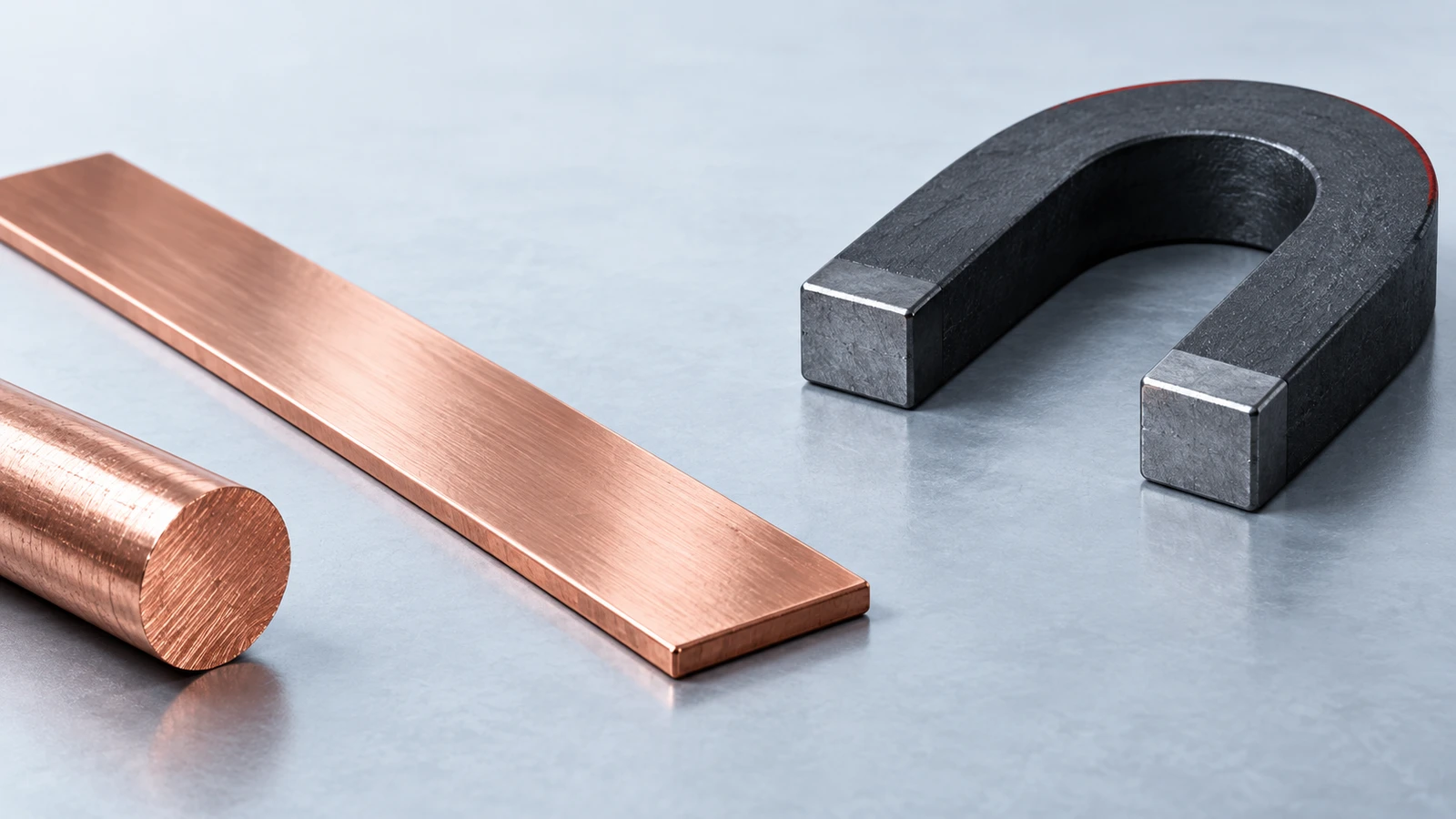
Why a moving magnet can react with copper
Copper is electrically conductive. A changing magnetic field can induce circulating currents in a conductor, and the magnetic effects of those currents oppose the change that produced them. This is the basis of the familiar eddy-current braking demonstration.
For example, a magnet moving near a suitable copper plate can experience resistance to its motion even though the plate is not acting like an iron magnet. The observation depends on relative motion, geometry, conductivity and field conditions. It should not be described as proof that copper has become ferromagnetic.
This distinction also matters in real equipment. Conductors near varying fields can experience induced-current losses. The absence of strong attraction to a stationary magnet does not establish that a metal part is irrelevant to an electromagnetic design.
Why transformer windings and cores use different materials
A transformer winding carries electric current. Its core provides the intended magnetic path. These are different jobs, so a material can be suitable for one and unsuitable for the other. Copper’s usefulness as a winding conductor does not depend on it behaving like a ferromagnetic core.
Likewise, changing from one conductor material to another is not decided by a magnet test. Electrical resistance, conductor area, thermal design, mechanical behavior, connections and manufacturing requirements all matter. The performance of the complete transformer must be evaluated from its actual design and test evidence.
The transformer types guide explains the broader equipment categories. Conductor material and magnetic-core construction are separate specifications within those categories.
Can copper alloys be magnetic?
Do not apply the pure-element answer to every copper alloy. Alloy composition and microstructure affect material behavior. The Copper Development Association’s physical-properties guide notes that some copper alloys containing iron-rich phases can show a slight ferromagnetic response.
Terms such as brass and bronze cover families rather than one fixed composition. A grade designation, material certificate and property requirement are more informative than color. Plating, cladding, steel inserts and attached fasteners can also change the response of a finished part.
| Observation | Possible explanation | Next useful check |
|---|---|---|
| A magnet does not visibly stick | The part may be non-ferromagnetic | Verify composition; absence of attraction does not prove copper |
| A copper-colored part is strongly attracted | Possible ferromagnetic substrate, insert or attached component | Inspect construction and material documentation |
| A moving magnet experiences drag | Induced-current interaction may be involved | Distinguish motion-dependent behavior from static attraction |
| A copper alloy shows a weak attraction | Composition or microstructure may contribute | Check the actual alloy and specified magnetic property |
A magnet test cannot establish copper purity
Many materials do not show strong attraction to a magnet. Therefore, failure to attract is not proof that a sample is pure copper. Nor does a copper-colored surface establish the material below it.
For procurement, define the required grade, dimensions, condition, surface treatment and relevant properties. Ask for traceable material evidence and an appropriate verification method if identity is critical. The test method should distinguish the proposed alternatives rather than merely produce an easy yes/no observation.
Consider an illustrative busbar enquiry. “Copper color and non-magnetic” leaves conductivity, alloy grade, section, temper and plating unresolved. A more useful enquiry names the required material and drawing, asks for its supporting documentation, and treats incoming inspection as verification against those requirements.
What electrical buyers should specify
- Material identity: the applicable grade and standard, rather than a color description.
- Electrical requirement: the relevant conductivity or resistance basis where needed.
- Mechanical condition: dimensions, temper, forming and connection requirements.
- Magnetic requirement: a defined property and method if it is relevant to the equipment.
- Traceability: batch evidence and agreed inspection records.
Keep these requirements proportionate to the component. A screening magnet observation can be useful for sorting or an initial investigation, but it should not replace a material acceptance plan for a critical conductor.
Common questions
Does a magnet stick to pure copper?
Not with the strong attraction normally meant by “sticks to a magnet.” Pure copper is diamagnetic.
Does electricity flowing in copper create a magnetic field?
Yes. The field associated with current is different from classifying the copper itself as a ferromagnetic material.
Does “magnet wire” mean the copper wire is magnetic?
No. The name refers to winding wire used in electromagnetic equipment. It does not establish that the copper conductor is ferromagnetic.