
 Huanghua Group Co., Ltd.
Types of Transformers: Classifications and Industrial Applications
Transformer types are best understood as several overlapping classifications: what the transformer does, how many phases it serves, how it is insulated and cooled, and where it is installed. “Single-phase,” “oil-immersed” and “pole-mounted” can all describe the same transformer. They are not competing choices in one list.
For a procurement enquiry, start with the electrical task. Then add the construction and installation requirements. This produces a useful specification instead of a long collection of transformer names.
Classify by the job the transformer performs
A step-up transformer raises voltage from one winding side to another; a step-down transformer reduces it. These descriptions state a voltage relationship. They do not, by themselves, identify insulation, enclosure or installation requirements.
Power and distribution transformers describe roles within an electrical network. Distribution equipment supplies downstream loads from the local network; larger network transformers may connect different network voltage levels. The terms are useful starting points, but a supplier still needs the actual winding voltages, capacity, frequency and duty.
Instrument transformers serve a different purpose: they provide scaled electrical quantities for measurement or protection. A current transformer or voltage transformer should not be confused with a unit intended to supply the main power demand of a building.
Common transformer types and what each name tells you
| Type | Defining feature | Typical reason to use it |
|---|---|---|
| Step-up / step-down | Output winding voltage is higher / lower than the input winding voltage in the intended application. | Match generation, distribution or equipment voltage levels. |
| Two-winding isolation transformer | Separate primary and secondary windings provide no direct conductive winding connection. | Provide the specified electrical separation as well as any required voltage change. |
| Autotransformer | A portion of the winding is common to input and output. | Adjust voltage where galvanic isolation is not required and the application permits this construction. |
| Current transformer (CT) | Provides a scaled representation of current for its specified measuring or protection duty. | Interface a power circuit with meters or protective relays. |
| Voltage transformer (VT/PT) | Provides a scaled voltage for its specified measuring or protection duty. | Supply voltage information to instruments and relays. |
| Control transformer | Designed for a specified control-circuit supply duty. | Supply controls with attention to their voltage and load requirements. |
Isolation does not require a change in voltage. A two-winding 1:1 unit can have equal nominal input and output voltages while retaining separate windings. An autotransformer can change voltage without providing that separation. Confusing these two properties can lead to an unsuitable substitution even when the proposed output voltage is correct.
A transformer may also be described as core-type or shell-type. These terms concern the arrangement of the magnetic core and windings: broadly, windings surround limbs in a core-type construction, whereas the core structure encloses more of the winding arrangement in a shell-type construction. They do not identify the phase count, insulation system or application by themselves.
Three examples of overlapping classifications
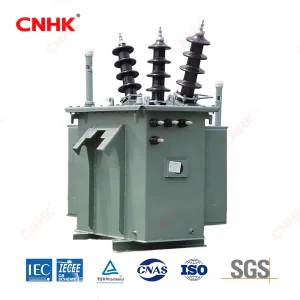
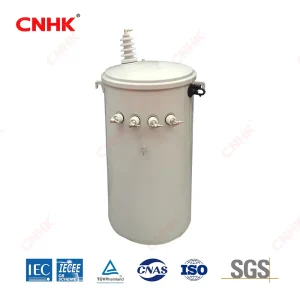
- Overhead local distribution: a single-phase, two-winding, step-down, oil-immersed, pole-mounted distribution transformer combines five different attributes.
- A building supply: a three-phase dry-type distribution transformer combines an electrical configuration, insulation construction and network role. Its room and cooling requirements still need definition.
- A protection measurement: a current transformer on a feeder is an instrument transformer. Its ratio and protection duty answer a different task from the kVA rating of the distribution transformer supplying that feeder.
These are illustrative descriptions, not claims that every configuration is available from Huanghua. The site’s cited product pages establish the available distribution-product routes. Treat other transformer families as explanatory context until a specific supplier model has been verified.
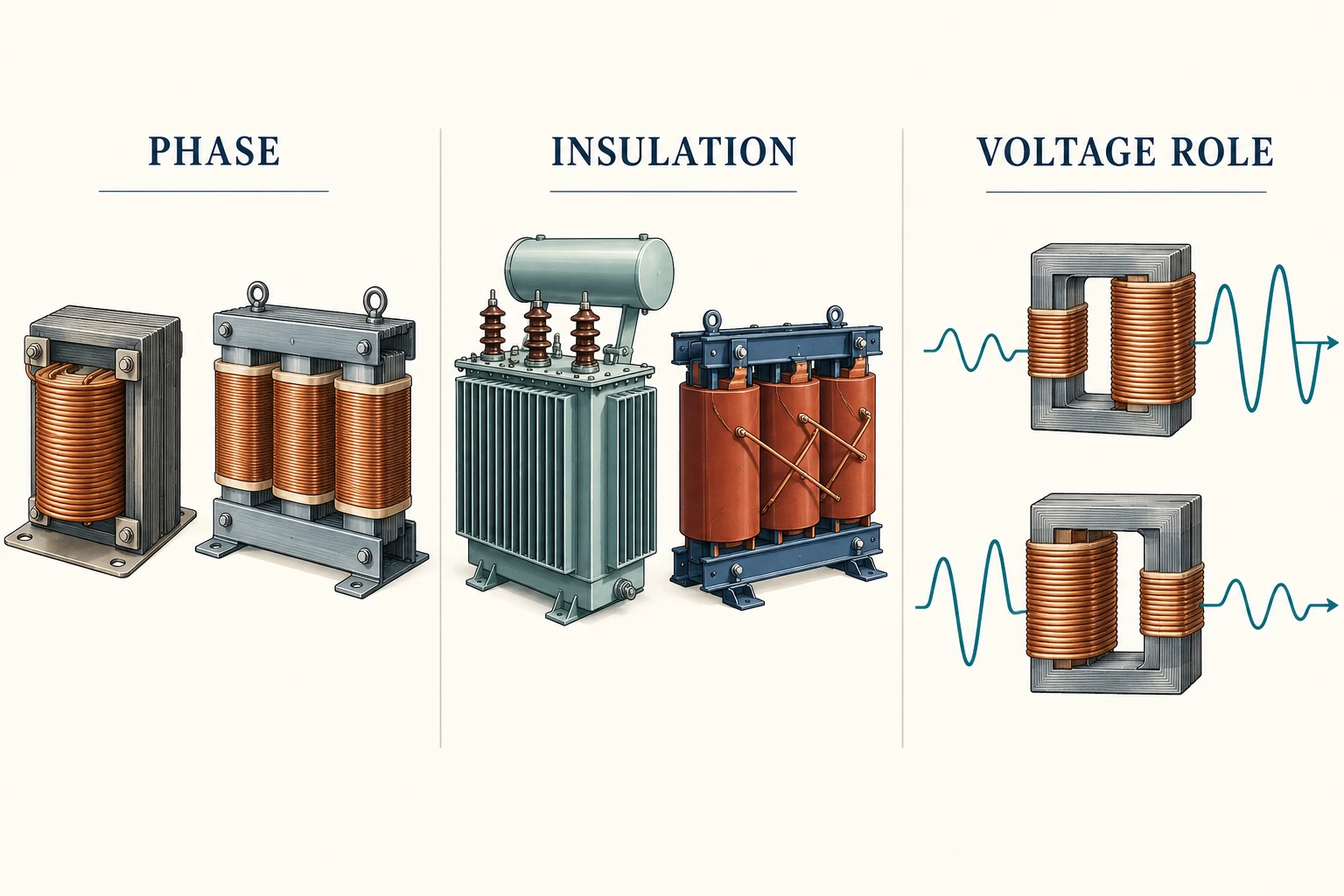
Keep phase and insulation on separate lines
| Classification | Common descriptions | What it helps decide |
|---|---|---|
| Phase | Single-phase; three-phase | Compatibility with the supply and load arrangement. |
| Voltage role | Step-up; step-down | The required relationship between winding voltages. |
| Insulation construction | Liquid-filled; dry-type | Which construction suits the installation constraints. |
| Installation | Pole; pad; indoor room; integrated station | Mechanical interfaces, access and equipment layout. |
| Application | Distribution; generation interface; measurement | The service the equipment must perform. |
The distinction prevents errors such as requesting “dry-type instead of three-phase.” One describes insulation construction; the other describes the electrical system. A three-phase unit may use either liquid-filled or dry-type construction.
Oil-immersed and dry-type are installation decisions too
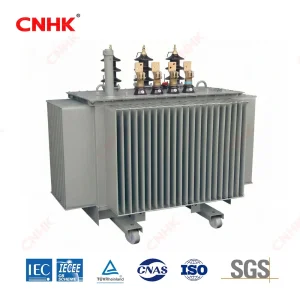
Liquid-filled and dry-type distribution transformers have different construction and thermal arrangements. Selecting between them involves more than whether the equipment will be indoors or outdoors. The project must address its location, ventilation, liquid-containment provisions where applicable, access and the environmental conditions stated by the manufacturer.
It is more useful to give a supplier the room or site requirements than to ask which type is “best.” A constrained plant room, a remote outdoor site and an integrated substation create different questions even when the electrical capacity is similar.
Mounting describes a real interface
A pole-mounted transformer needs a compatible mounting arrangement and network connection design. A pad-mounted or indoor unit creates a different set of access, foundation and cable-entry questions. A photograph that looks suitable cannot confirm those interfaces.
Huanghua’s single-phase oil-immersed distribution transformer is described for pole mounting. Its three-phase oil-immersed distribution transformer addresses a different distribution configuration. These are examples of combined attributes, rather than evidence that one design can replace the other.