
 Huanghua Group Co., Ltd.
Fuse Box vs Circuit Breaker: Protection, Maintenance and Selection
A fuse box uses replaceable fuse elements for circuit protection; a circuit-breaker panel uses resettable protective devices. Both can form part of a properly designed installation. Whether an existing fuse box should be replaced depends on its condition, protection functions, capacity and compatibility with present requirements—not its age or the presence of fuses alone.
The phrase “fuse box versus circuit breaker” also compares unlike things: a fuse box is an assembly, while a circuit breaker is a device. A useful assessment compares the complete existing board with the proposed replacement assembly, including the circuits and protection that each supports.
What happens when each device operates?
A fuse interrupts an overcurrent by melting its element and extinguishing the resulting arc within its designed limits. After operation, the correct fuse must be replaced. The replacement must match the required characteristics; selecting only the same ampere value can overlook voltage, breaking capacity, speed and physical class.
A circuit breaker uses a trip mechanism and interrupting contacts. After the cause of operation has been established and the equipment is suitable for return to service, it may be reset according to the manufacturer’s procedure. Being resettable does not mean a breaker is undamaged after every fault, or that repeated resetting is acceptable fault finding.
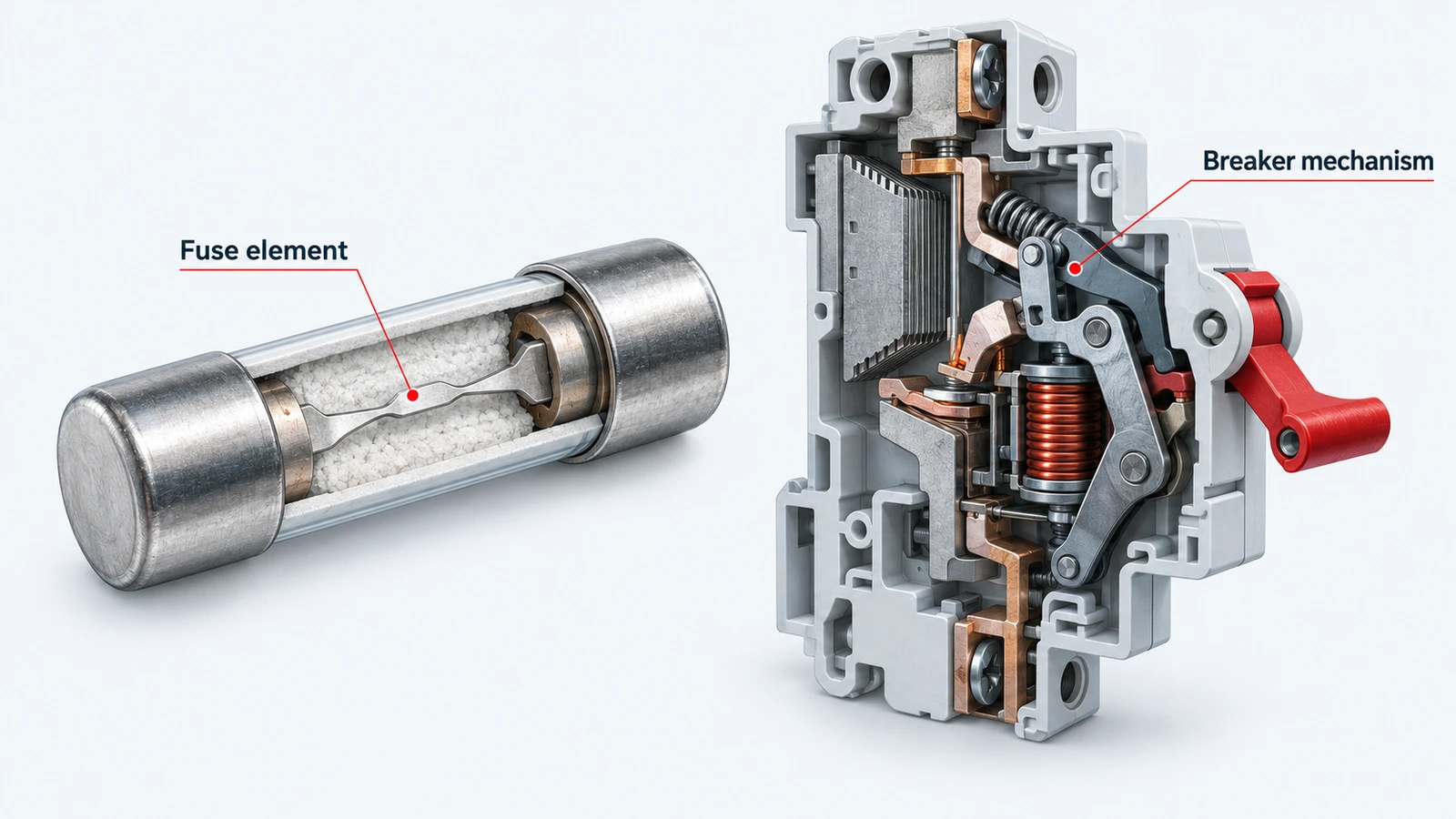
Compare the assembly, not just the handle
| Assessment point | Fuse-based board | Breaker-based board |
|---|---|---|
| After protective operation | Correct replacement fuse and checks are needed | Investigation and product-specific checks precede resetting |
| Protection performance | Depends on fuse class, characteristic and application | Depends on trip characteristic, settings and application |
| Residual-current protection | Must be identified separately | Must be identified separately unless combined in the selected device |
| Maintenance and expansion | Condition, spare availability and assembly limits matter | Condition, compatible devices and assembly limits matter |
A modern-looking breaker board is not automatically adequate. Incorrect breakers, missing covers, overheated terminals, unsuitable cable entries or unverified alterations can undermine an otherwise appropriate design. Equally, the word “fuse” does not prove that an installation lacks effective overcurrent protection.
Are fuses faster than circuit breakers?
There is no useful universal answer. A device’s operating time depends on the magnitude and duration of the current and on its specific characteristic. Time-delay fuses exist, as do breakers with different instantaneous and delayed operating characteristics. Compare the manufacturer’s data at the relevant current rather than assigning one response time to an entire category.
For demanding fault duties, let-through energy, peak current, interrupting capability and coordination may matter as much as ordinary overload behavior. Eaton’s fuse guidance distinguishes melting and clearing behavior. Those values are not interchangeable, and a single point on a curve cannot represent every operating condition.
Selective coordination adds another question: will the device nearest the fault operate while upstream supplies remain available? Manufacturer tables or supported studies are needed. A downstream device’s lower ampere rating alone does not establish coordination with the upstream protection.
When an existing fuse box deserves professional assessment
Visible damage, burning odors, repeated protective operations, missing barriers, unsuitable replacements or evidence of overheating require attention. So do planned changes that alter the circuit demand or required protective functions. A new kitchen, EV charger, workshop or building extension can change the design question even if the old installation seemed to operate normally.
The assessment should establish the incoming supply, board rating, available fault current, circuit condition, earthing and bonding, residual-current requirements and space for suitable protection. Local installation rules and inspection requirements determine what work is necessary. A photograph of the board exterior cannot answer all of these questions.
Do not fit a larger fuse or breaker simply to stop nuisance operation. If a device is opening because a circuit is overloaded, increasing its rating can leave the conductors inadequately protected. The load, cable and protection must be checked together.
What a replacement quotation should explain
- Reason for the work: defects, additional loads, required functions or capacity limitations.
- Scope: which board, circuits, incoming connections and associated remedial work are included.
- Protection: overcurrent and residual-current arrangements, fault capability and circuit separation.
- Compatibility: devices supported by the replacement assembly and manufacturer instructions.
- Handover: circuit schedule, test results, settings where applicable, labels and local documentation.
Compare quotations on that basis rather than counting the number of new breaker handles. One proposal may include circuit investigation and remedial work, while another may describe only the assembly replacement. The apparent price difference can reflect an important difference in scope.
Industrial systems may deliberately use both
Fuse and circuit-breaker protection are not always competing alternatives. An industrial distribution design may use fuses in one branch and breakers elsewhere because the loads, maintenance needs and coordination differ. The relevant choice is made at system level.
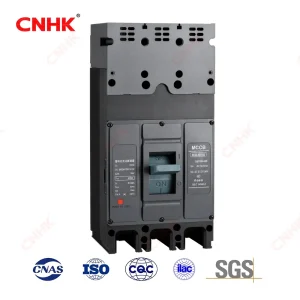
For higher-current distribution duties, the MCCB guide explains the distinction between frame, trip and fault ratings. Those ratings should not be confused with the amperage of an individual household branch circuit.
Common questions
Does every old fuse box need immediate replacement?
Age alone does not establish condition or compliance. A qualified assessment should identify defects, protective functions and the requirements triggered by the proposed work.
Can a breaker be installed in a fuse position?
Only an arrangement supported for that assembly and application should be considered. Physical fit is not proof of electrical, thermal or regulatory compatibility.
Will replacing a fuse box fix repeated trips?
Not necessarily. A load or wiring fault may remain after the board is changed. Investigate the cause rather than assuming the protective device is the problem.