
 Huanghua Group Co., Ltd.







RCD vs MCB: Protection Functions and Selection Questions
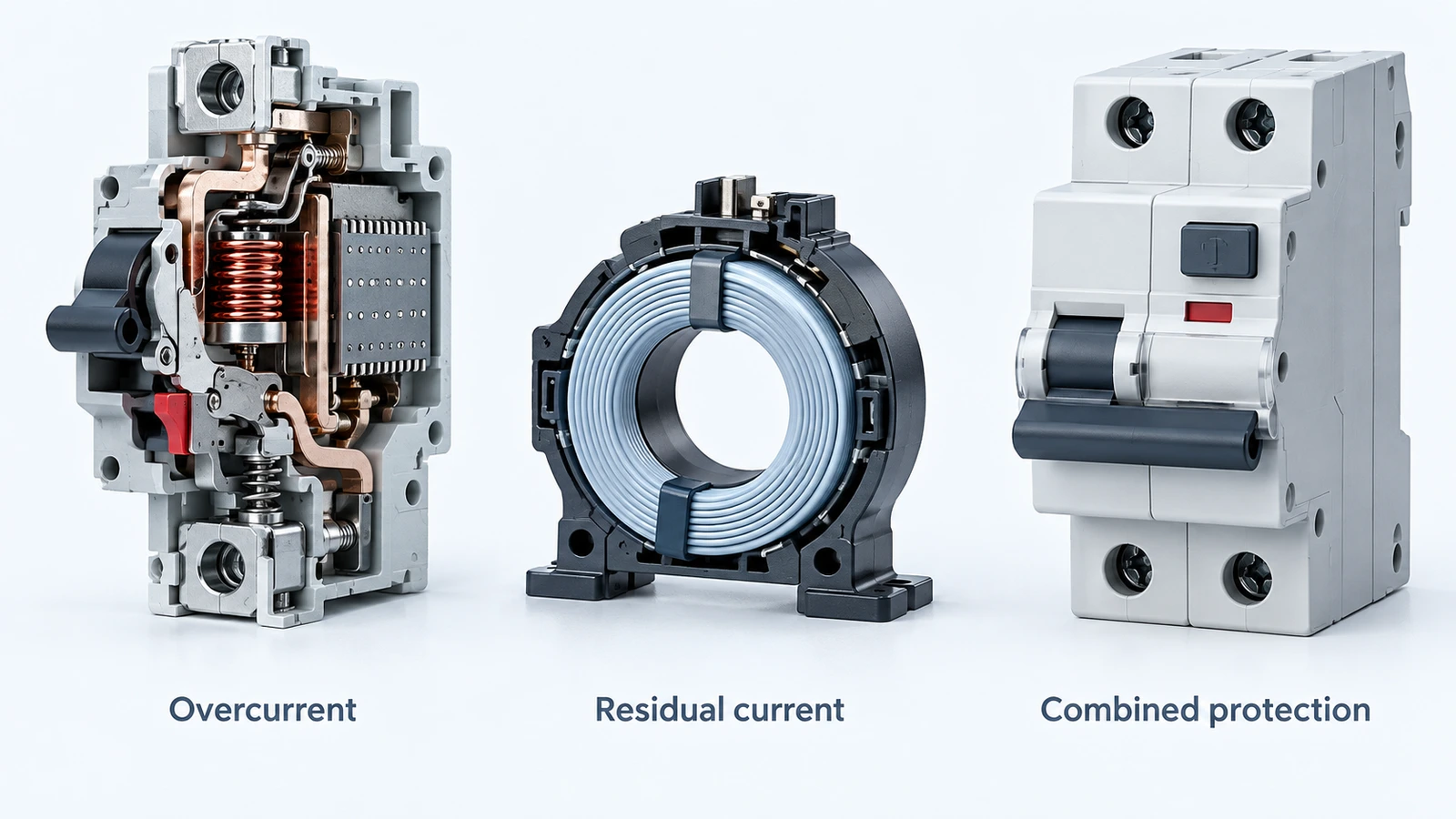
An RCD detects residual current; an MCB provides overcurrent protection. They respond to different electrical conditions. An RCD does not automatically replace an MCB, and an MCB does not necessarily provide the residual-current protection required for a circuit. A combined RCBO can provide both functions within its documented ratings.
The distinction matters when a breaker trips, when a distribution board is specified, and when two quotations appear to offer the same protection. Similar case sizes and operating handles can hide very different functions. Start with the fault being addressed, then identify the equipment that is intended to disconnect it.
Two protection functions, two different measurements
An MCB monitors current in its protected path. In a conventional thermal-magnetic design, the thermal element responds to sustained overload and the magnetic element responds to sufficiently high short-circuit current. The time-current characteristic determines how it behaves; a current rating is not an exact instantaneous trip threshold.
An RCD monitors the balance of the circuit’s live-conductor currents. Current leaving by another path can create an imbalance that causes operation. An RCCB is an RCD without integral overcurrent protection. An RCBO combines residual-current and overcurrent functions, which is why “RCD” and “RCCB” should not be used interchangeably in every specification.
RCD versus MCB at a glance
| Question | RCD function | MCB function |
|---|---|---|
| What is detected? | Residual-current imbalance | Overcurrent according to the device characteristic |
| What rating is especially relevant? | Residual operating current, alongside carrying and coordination ratings | Rated current, trip characteristic and short-circuit capability |
| Does it cover every electrical hazard? | No | No |
| Can one combined device do both? | An appropriately selected RCBO can combine the functions | |
This comparison describes functions, not a complete installation design. Earthing arrangements, conductor sizing, isolation, protective bonding, equipment instructions and local installation rules remain relevant. The IET’s guidance on consumer units explains why an RCCB also needs suitable overload protection.
Three situations that explain the difference
A sustained overload on an otherwise intact circuit
Suppose several loads draw more current than a circuit is designed to carry. If outgoing and returning currents still balance, a residual-current device may have no reason to operate. The overcurrent protection must address the overload. A large ampere marking on an RCCB does not mean that it provides an overload trip at that value.
Leakage from equipment to an unintended return path
A fault may create a residual current that is small compared with a circuit’s normal load. A conventional MCB may not see enough overcurrent to operate promptly. Suitable residual-current protection can address this different condition, subject to the device type, sensitivity and installation design.
A short circuit between live conductors
A line-to-neutral fault can produce very high current while the currents passing through an RCD sensing core remain balanced. Overcurrent protection and the equipment’s fault capability are therefore essential. An RCD should never be described as a universal short-circuit protective device.
Why a trip does not identify the root cause
A tripped RCD can be associated with an insulation fault, accumulated leakage, a neutral connection problem, an unsuitable device type or a transient disturbance. A tripped MCB can be associated with overload, short circuit, starting conditions or other application issues. The operated handle tells you which device opened, but not necessarily why the condition arose.
Repeated resetting is not a diagnostic method. Note which circuit was affected, what equipment was running, when the trip occurred and whether there were recent changes. This information helps a qualified person investigate without guessing from the breaker label alone.
For professional fault finding, distinguish a device-function test from a circuit investigation. Proving that a test button operates does not establish every circuit parameter. Conversely, finding a circuit fault does not by itself prove the protective device retains all of its original performance.
Choosing between shared RCD protection and individual RCBOs
A shared RCCB arrangement and individual RCBO arrangements can have different implications for fault isolation, continuity of service, board space and maintenance. The better option depends on the design and applicable rules. It is not enough to compare the price of one device against several devices while ignoring the effect of a single fault on other circuits.
For example, a fault on one outgoing circuit under a shared RCD may interrupt other circuits in that group. An individual RCBO arrangement can improve circuit separation, but it still needs the correct device selection, neutral routing and distribution-board compatibility. Neither arrangement should be promised to eliminate all unwanted tripping.
Specify the residual-current type needed for the connected equipment. Electronic loads may affect the waveform of leakage current. Choosing a more sensitive device indiscriminately can create coordination or operational problems; choosing an unsuitable type can fail to address the intended condition.
A practical specification check
- List the required protective functions separately: overload, short circuit and residual current.
- Record supply voltage, phases, earthing arrangement and the circuit’s load characteristics.
- Confirm conductor protection, fault-current capability and manufacturer-supported combinations.
- Identify whether a selected device is an RCCB, RCBO or another RCD arrangement.
- Specify the commissioning and maintenance evidence required for the actual installation.
For a broader comparison of overcurrent equipment, see MCB versus MCCB. That comparison concerns another selection question: the device category and capability needed for distribution duties.
Common questions
Which is safer, an RCD or an MCB?
They address different conditions. Safety depends on the complete protective arrangement, not on choosing one abbreviation over the other.
Does an MCB protect against electric shock?
Overcurrent protection can form part of fault protection in a correctly designed system, but an MCB is not a substitute for required additional residual-current protection. The installation’s earthing and disconnection requirements must be assessed together.
Does a test button mean a device is an RCD?
A test button is a clue, not a full identification method. Read the complete markings and product documentation. Other equipment can also have test controls.