
 Huanghua Group Co., Ltd.
What Causes a Transformer to Blow? Faults, Warning Signs and Safe Next Steps
A transformer can fail when its insulation, windings, connections or other components can no longer withstand the electrical and thermal conditions they face. Overload, inadequate cooling, moisture, damaged connections and external electrical events can contribute. However, a loud bang near a transformer does not prove that the transformer tank or windings have failed; nearby protective equipment may also operate noisily.
If there is smoke, fire, leaking fluid or a fallen conductor, keep away and contact the utility or site emergency team. Do not approach the equipment to identify the damaged part or attempt to restore power.
“Blown transformer” describes an event, not a cause
The phrase is often used for an outage accompanied by a flash or loud sound. It does not distinguish an internal transformer fault from an external fault, a protective-device operation or another equipment failure.
The investigating team needs the event sequence, protection records and equipment condition. A description such as “the supply failed after a flash near the pole” is more useful than an unsupported diagnosis. Record observations from a safe location and let the responsible operator identify the asset.
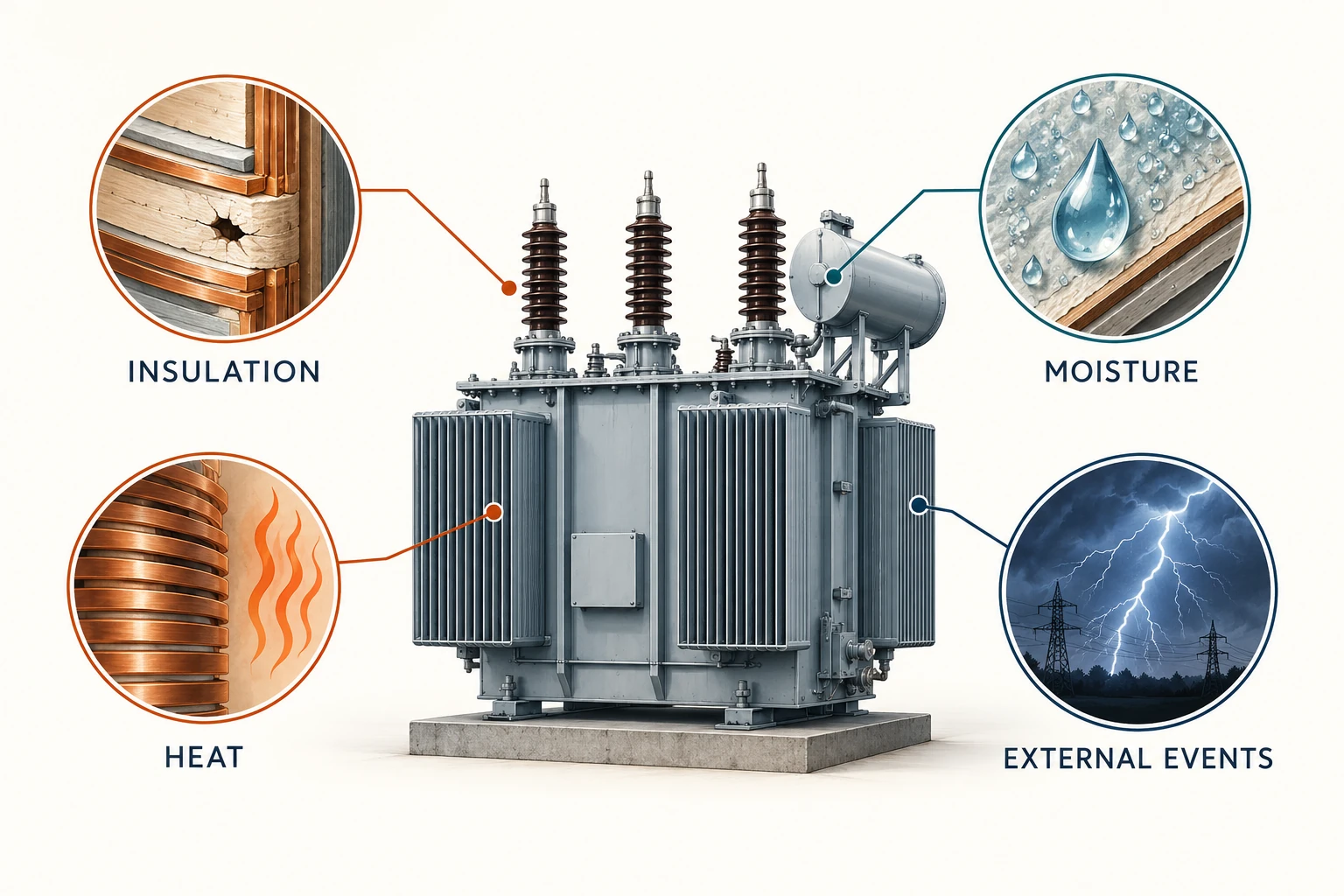
Common mechanisms behind a transformer fault
| Possible contributor | What it can affect | Useful investigation context |
|---|---|---|
| Overload or poor cooling | Thermal stress on the transformer and its insulation. | Load history, ambient conditions and cooling condition. |
| Moisture or contamination | Insulating properties and condition. | Storage/exposure history and suitable diagnostic results. |
| Connection or component defects | Local heating, current paths or insulation interfaces. | Inspection and maintenance records. |
| External electrical events | Electrical stress imposed on the equipment. | System-event and protection records. |
Several contributors can occur together. For example, a thermal problem may be associated with both the load duty and the installation’s ventilation. Replacing a failed unit without examining the operating conditions may leave the underlying issue unresolved.
Warning signs need context
A new unusual noise, visible damage, abnormal indications or a reported change in operating temperature deserves attention from the responsible maintenance team. None is a universal diagnosis by itself. The significance depends on the equipment, its baseline and the surrounding conditions.
Compare events with maintenance and operating records. When did the change begin? Was there a recent load increase, storage period, alteration or electrical event? These questions help organize an investigation without asking an unqualified observer to open equipment or perform measurements.
Why a protection operation is not the whole answer
Protection may disconnect a circuit in response to a detected condition. Its operation provides valuable evidence, but the team still needs to determine why it operated and what equipment was affected. An outage that clears quickly does not establish that the installation is safe to re-energize.
Preserve the available event records before they are overwritten or reset. Restoration should follow the operator’s investigation and authorization process rather than repeated attempts to close a breaker or replace a fuse.
Build a useful incident record
- Record the time, location and equipment designation from existing records.
- Describe the observed sequence without guessing the internal fault.
- Retain protection indications, alarms and operating data available through authorized systems.
- Record recent loading, maintenance, storage or configuration changes.
- Keep inspection and test findings linked to the asset and the event.
The technical team can then decide which inspections and tests are appropriate. A generic internet list of failure causes cannot determine the condition of a particular unit.
Replacement should address the original duty
If replacement is required, review the load, supply, insulation and installation requirements alongside the failure findings. A Huanghua distribution transformer enquiry should state these conditions and identify any change from the original design.
Ask for a proposed configuration and documentation that address the actual application. Increasing the nameplate capacity without understanding the event is not, by itself, a corrective action for every transformer failure.