
 Huanghua Group Co., Ltd.








MCB vs MCCB: Key Differences and Selection Checks
An MCB is a miniature circuit breaker; an MCCB is a molded case circuit breaker. Both families include devices that protect circuits against overload and short circuit. The useful difference is the range of protection, ratings and installation options available in a particular product—not a single ampere value that separates every MCB from every MCCB.
MCBs commonly serve final circuits in modular distribution boards. MCCBs are often selected for feeders and equipment circuits where the project needs a different frame, fault rating, trip unit or connection arrangement. Neither family name proves that a device is suitable for the circuit.
MCB vs MCCB: compare the actual configuration
| Selection question | MCB | MCCB |
|---|---|---|
| How is protection specified? | Commonly by rated current and a defined trip characteristic. | By the selected trip unit; fixed and adjustable versions exist. |
| How does it fit the assembly? | Often a compact modular device. | Frame dimensions and connection options need explicit confirmation. |
| Can it interrupt the available fault? | Check the published breaking rating at the relevant voltage. | Check the same conditions; a larger enclosure is not proof. |
| Are remote commands available? | Compatible accessories may be offered. | Accessories depend on frame and order code. |
| Does it provide earth-leakage protection? | Do not infer this from “MCB.” | Do not infer this from “MCCB.” |
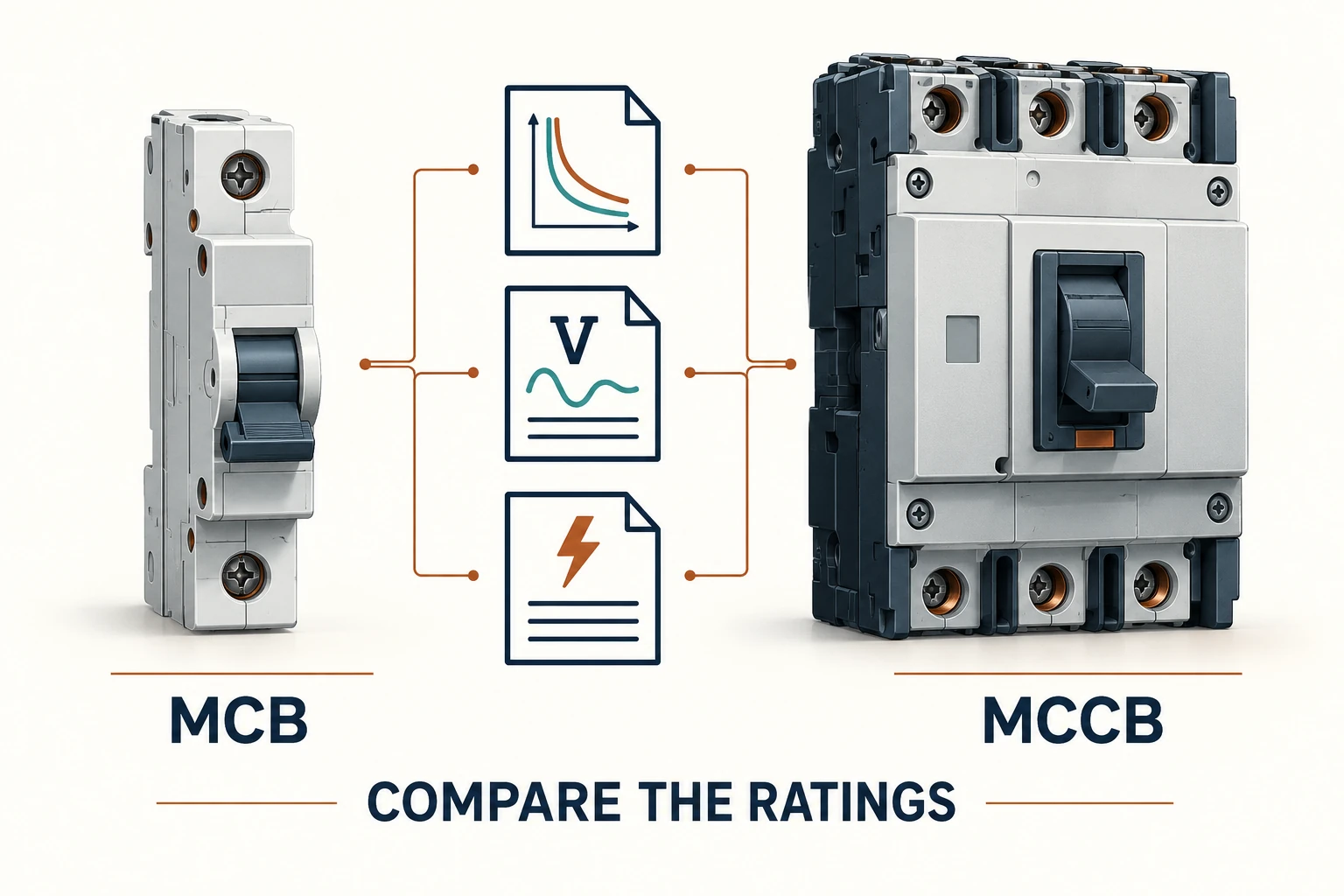
Adjustment is a feature, not the definition of an MCCB
A thermal-magnetic breaker combines a thermal response to sustained overcurrent with a magnetic response to sufficiently high current. An electronic trip unit uses sensing and electronic processing to apply its available protection functions. The selected unit determines which thresholds or delays can be adjusted.
Some comparisons say that every MCCB is adjustable. Manufacturer documentation includes fixed thermal-magnetic MCCBs, so that rule can mislead a buyer. Request the trip-unit designation and its time-current curve. A catalog photograph showing several knobs is not a substitute for the adjustment ranges and permitted combinations.
Adjustment also creates an engineering responsibility: a setting must match the protected circuit and the protection study. “More adjustable” does not mean that a purchaser should choose settings without the system data.
Current rating and fault rating answer different questions
The load-current selection concerns normal operation. The short-circuit breaking rating concerns interruption under specified fault conditions. A device can be adequate for the expected load and still be unsuitable for the available fault current at its installation point.
For ratings identified as Icu and Ics, distinguish ultimate short-circuit breaking capacity from service short-circuit breaking capacity. Compare values at the same stated operating voltage and applicable configuration. Do not place two prominent catalog numbers side by side when one describes a different voltage or test duty.
A useful quotation comparison has separate cells for operating voltage, rated current, trip-unit type, fault rating and rating basis. Leaving one blank exposes the missing information instead of hiding it behind a broad “equivalent” description.
Two applications show why the family name is not enough
A final lighting circuit: the task is to protect the circuit conductors while accommodating the connected load’s normal behavior. A modular MCB may suit the board and the duty. The designer still checks load current, conductor protection, breaking capacity and the manufacturer’s trip characteristic. Selecting a different curve solely to stop nuisance tripping can conceal an unresolved inrush or circuit-design issue.
A distribution feeder: the task may require a particular protection delay, a remote opening accessory and a coordinated relationship with downstream breakers. An MCCB can provide a suitable route, but its trip unit and accessories must actually include those functions. A fixed-trip MCCB cannot be treated as an adjustable electronic version merely because both belong to the same family.
For either application, separate the time-current curve from the breaking-capacity rating. The curve describes operating behavior across specified current conditions; it is not proof of the maximum short-circuit duty the device can interrupt. A valid comparison therefore combines the curve, rated data and installation requirements rather than selecting the device with the largest advertised ampere value.
Coordination can change the choice
A feeder breaker and its downstream devices work as a protection system. Selecting each independently from its load current does not establish selectivity. Ask the designer or supplier for the applicable coordination evidence for the exact upstream and downstream models.
For example, a facility may want a fault on one outgoing circuit to leave the other circuits available. That is a project requirement to evaluate using the protection arrangement; it is not a benefit guaranteed by selecting an MCCB. Likewise, an accessory for remote opening must match the breaker and its control supply.
Turn the comparison into a usable enquiry
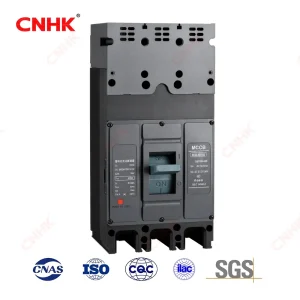
Huanghua’s HKM1 series provides an MCCB product route with release and connection alternatives. The HKM1E electronic-trip series is a separate route when adjustable electronic protection is part of the enquiry. Confirm the required functions against the selected version; these options do not establish interchangeability with an existing board.