
 Huanghua Group Co., Ltd.








RCCB and ELCB: Full Forms, Protection Principles and Key Differences
RCCB stands for residual current circuit breaker; ELCB stands for earth leakage circuit breaker. The important difference is the sensing principle. An RCCB detects an imbalance between the currents in a circuit’s live conductors. ELCB is an older and less consistent label: it can describe a historical voltage-operated earth-leakage device, while some manufacturers also use it for current-operated equipment.
For a student, the full forms may be enough to answer an examination question. For a panel builder, maintenance team or buyer, they are only the beginning. A purchase order that says “ELCB, 63 A” leaves the protection function, leakage sensitivity, applicable standard and overcurrent provision unresolved.
What each abbreviation tells you
| Label | Meaning | What to establish before selection |
|---|---|---|
| RCD | Residual current device: the broader family | Whether the device also provides overcurrent protection |
| RCCB | Residual current circuit breaker, without integral overcurrent protection | Rated current, residual operating current and coordinated protective device |
| RCBO | Residual current operated circuit breaker with integral overcurrent protection | Both residual-current and overcurrent characteristics |
| ELCB | Earth leakage circuit breaker | The actual sensing method and manufacturer’s product definition |
The word “breaker” in RCCB does not mean it can replace an MCB or fuse. Schneider Electric’s RCCB explanation explicitly distinguishes residual-current protection from thermal-magnetic overcurrent protection. The equipment’s documented functions, rather than the abbreviation alone, determine what protection is present.
How an RCCB detects leakage
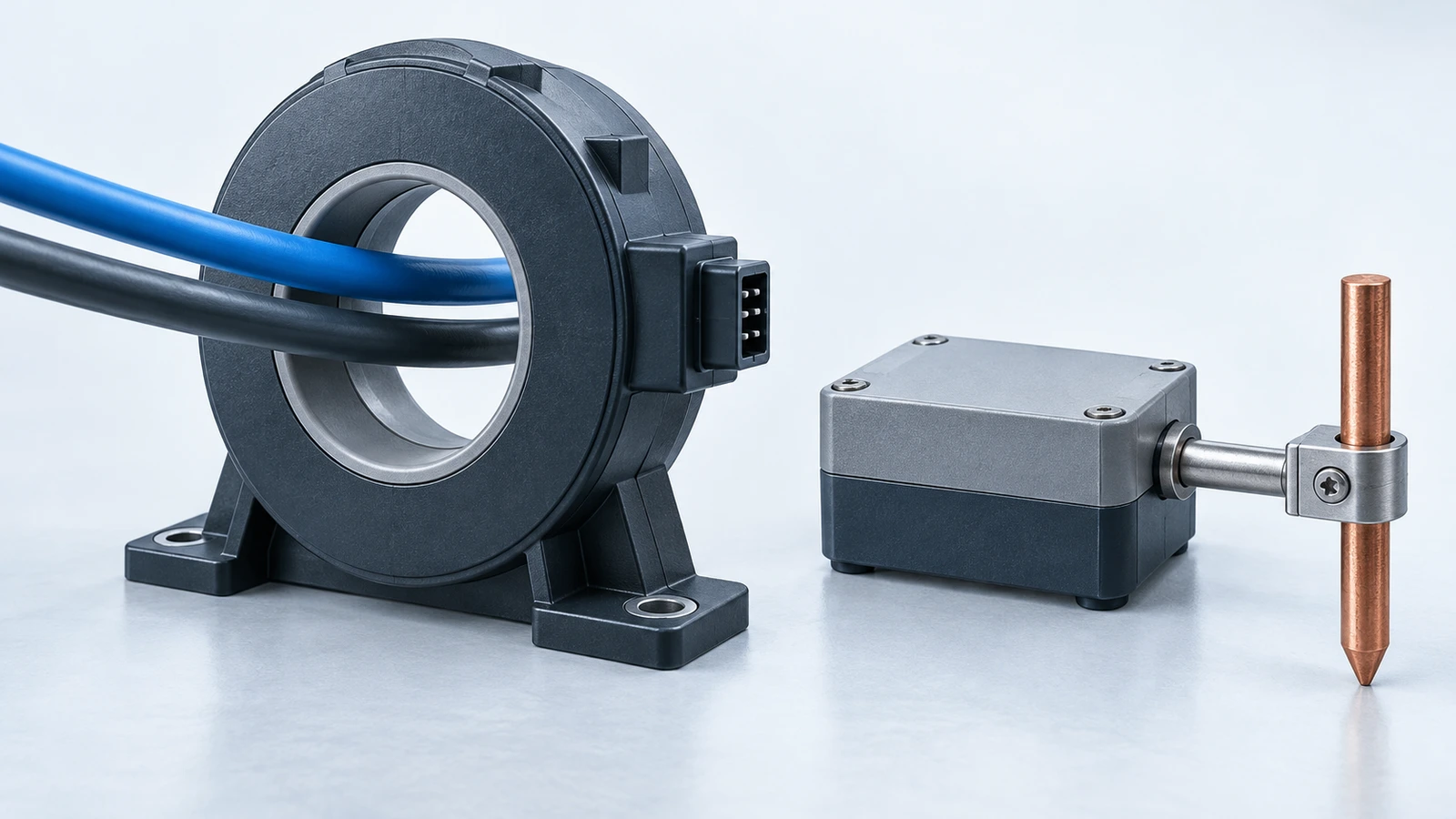
In a single-phase circuit, current travels to a load through the line conductor and returns through neutral. During normal operation, the currents passing through the sensing core balance. If some current returns by another path, the resulting imbalance can operate the residual-current mechanism.
In a three-phase application, the same principle applies to the vector sum of the live conductors included in the sensing arrangement. It is not a measurement of how much useful power the load consumes. A small imbalance may matter even when the total load current is far below the circuit’s overcurrent rating.
This also explains a limitation: an RCD responds to residual current, not every possible shock scenario. For example, contact between line and neutral may not create the imbalance needed for operation. Earthing, bonding, insulation, enclosures and suitable circuit protection still form part of the installation’s protective measures.
Why the term ELCB needs care
A historical voltage-operated ELCB monitored a voltage rise between protected metalwork and an earth reference. That is different from measuring the balance of the circuit conductors. Its effectiveness depended on the intended earthing and sensing arrangement, so a modern RCCB should not be treated as a direct interchangeable replacement based on name or physical size.
Indian government electrician training material distinguishes voltage-operated and current-operated ELCBs. Manufacturer terminology can also vary by market. The practical response is to identify the actual device from its model, diagram, markings and manual. Do not infer the operating principle solely from a seller’s category heading.
When investigating an old installation, record what is fitted and refer the replacement design to a competent electrical professional. A new device may require a different neutral arrangement, different overcurrent coordination or changes to the distribution board. Changing the label in a specification does not establish compatibility.
Read amperes and milliamperes separately
An RCCB may show a rated current in amperes and a rated residual operating current in milliamperes. These are different quantities. The first concerns the current the equipment is designed to carry under its specified conditions; the second describes residual-current sensitivity. Neither alone proves the complete circuit is correctly protected.
Consider a purely illustrative request for a “63 A, 30 mA RCCB.” It identifies two ratings but does not establish the poles, supply voltage, residual-current type, short-circuit coordination, installation environment or local requirements. It also does not mean that the device trips on an ordinary 63 A overload. The IET explains why an RCCB needs an appropriate arrangement to protect it against overload.
A more useful procurement specification
Instead of asking whether RCCB is “better than ELCB,” write a functional description. The following fields let an engineer or supplier check a proposed device against a real circuit.
- Supply and circuit: AC voltage, frequency, phases, neutral arrangement and earthing system.
- Protective function: residual-current protection only, or a combined device with overcurrent protection.
- Load characteristics: electronic power conversion, drives or other equipment that can affect the residual waveform.
- Device ratings: rated current, residual operating current, poles, operating characteristics and applicable product standard.
- Coordination: the upstream or downstream overcurrent device and the manufacturer’s supported combination.
- Installation evidence: distribution-board compatibility, terminal requirements, circuit identification and commissioning records.
A load with power electronics may require a different RCD type from a simple resistive circuit. Do not select Type AC, A, F or B from price or letter order. Use the load manufacturer’s requirements, the protective-device documentation and the installation rules adopted for the project.
RCCB versus an earth-fault relay arrangement
Larger distribution systems may use a residual-current transformer, protection relay and separate interrupting device rather than a compact RCCB. The sensing concept can be related, but the complete trip chain must be engineered and verified. A transformer or relay by itself does not disconnect a fault.
The core-balance current transformer guide explains that separate sensing arrangement. Keep it separate from an RCCB specification: the sensor, relay, control power and breaker release each have their own role.
Common questions
Are RCCB and RCD the same?
RCD is the broader term. An RCCB is one kind of RCD; an RCBO is another, with integral overcurrent protection. Always check the actual product’s functions.
Does an RCCB work without earthing?
Its sensing principle is current imbalance, but that is not permission to omit protective earthing or bonding. Installation protection must be assessed as a complete system under the applicable rules.
Can an MCB and RCCB be replaced by an RCBO?
A suitable RCBO can combine those protection functions, but replacement requires confirmation of ratings, circuit configuration, board compatibility and coordination. It is a design decision, not an abbreviation conversion.