
 Huanghua Group Co., Ltd.






Load Factor in Electricity: Formula, Worked Example and Common Mix-Ups
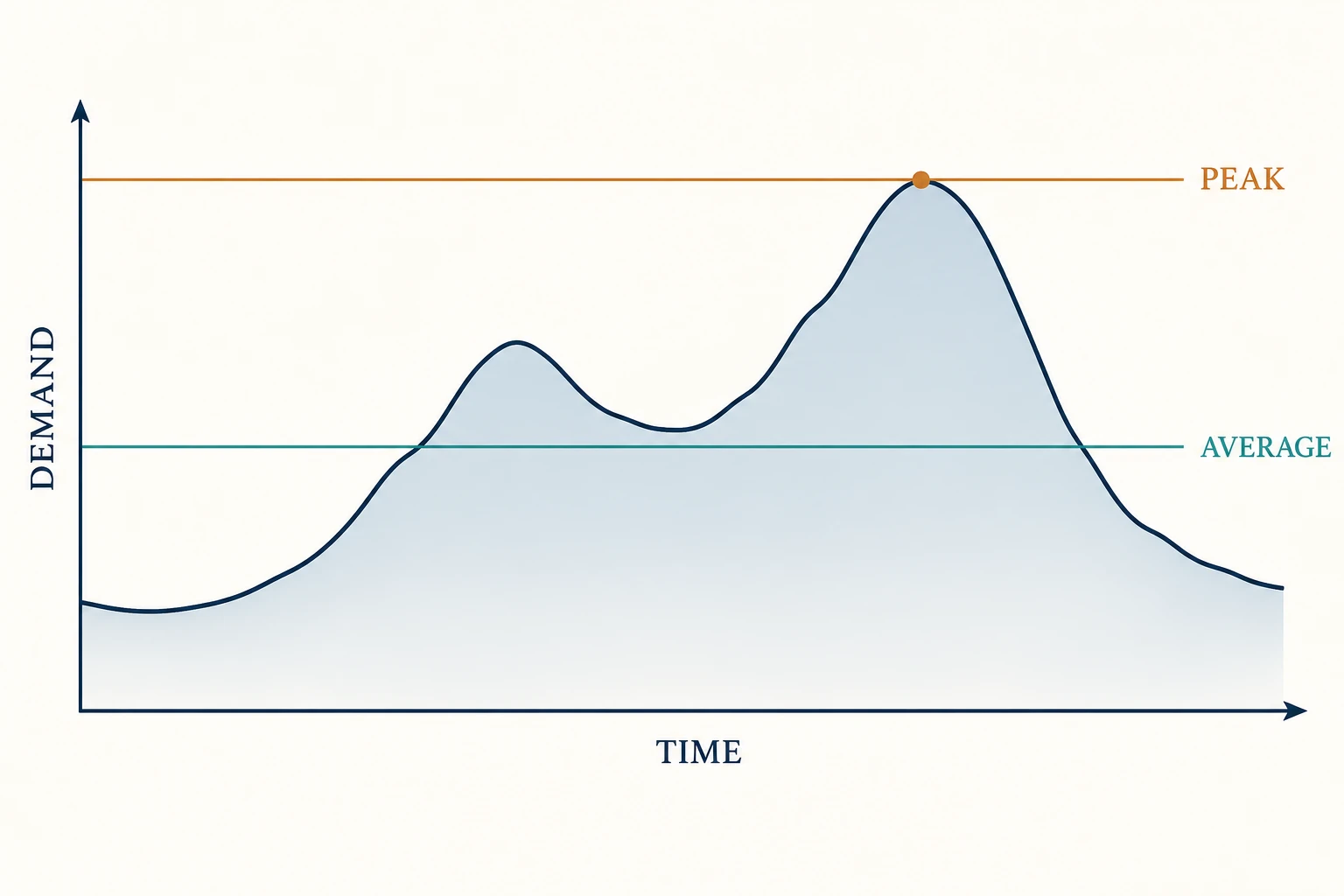
Load factor in electricity is average demand divided by peak demand over the same period. It describes how steadily the electrical capacity represented by that peak is used. A higher load factor means the average demand is closer to the peak; it does not automatically mean lower energy use or better power factor.
To calculate it from an electricity record, use energy in kWh, peak demand in kW and the number of hours in the matching period. The measurement boundary and demand interval must be consistent.
How do you calculate electrical load factor?
Load factor = average demand ÷ peak demand
Since average demand equals energy divided by elapsed hours:
Load factor = energy (kWh) ÷ [peak demand (kW) × period (h)]
Multiply the result by 100 to express it as a percentage. The units cancel because kW multiplied by hours gives kWh. Do not combine a monthly energy total with a peak from a different month.
Worked case: calculate monthly load factor from electricity data
Consider an illustrative facility with 72,000 kWh of consumption during a 30-day period and a recorded peak demand of 200 kW over that same period. These are teaching inputs, not measurements from a Huanghua customer.
| Calculation | Result |
|---|---|
| Period: 30 × 24 | 720 hours |
| Average demand: 72,000 ÷ 720 | 100 kW |
| Load factor: 100 ÷ 200 | 0.50, or 50% |
The average demand was half the period’s peak. This does not mean that every machine ran at half load, or that the plant operated for exactly half the month. Different demand profiles can produce the same ratio.
Why the time window changes the answer
A weekday-only analysis answers a different question from a full-calendar-month analysis. If energy is summed over working hours but the denominator includes all calendar hours, label that choice clearly; otherwise comparisons can be misleading.
Peak demand also depends on the measurement interval used by the meter or analysis. Keep that interval consistent when comparing periods. A billing demand determined by tariff rules may not be identical to the measured peak needed for this calculation, so identify the field you are using.
A practical spreadsheet should retain the start and end times, energy boundary, elapsed hours, peak-demand value and demand-interval definition beside the calculated percentage.
Load factor is not power factor
| Metric | Basic question |
|---|---|
| Load factor | How does average demand compare with peak demand over time? |
| Power factor | How does real power compare with apparent power under the stated measurement conditions? |
| Demand factor | How does maximum demand compare with the total connected load? |
A facility can have a steady demand profile and still need to examine its power factor. It can also have a high connected load but a lower maximum demand because equipment does not all operate together. The ratios describe different relationships.
Interpret an improvement before calling it a saving
Suppose the example’s energy remains 72,000 kWh while its peak falls to 160 kW. The load factor becomes 72,000 ÷ (160 × 720) = 62.5%. Energy has not fallen; the profile has become less peaky by this measure.
Alternatively, adding consumption during previously quiet hours can raise load factor. That is why a larger percentage alone cannot prove energy savings. Any cost analysis also needs the applicable tariff and the actual demand/energy changes.
Case comparison: can the same load factor mean the same transformer duty?
No. Consider two hypothetical facilities over the same 720-hour month. Facility A uses 72,000 kWh and has a 200 kW peak; Facility B uses 36,000 kWh and has a 100 kW peak. Their average demands are 100 kW and 50 kW respectively. Both load factors are 50%, although one facility’s peak is twice the other’s.
The decision is to retain the underlying demand data when describing transformer duty. The percentage alone discards the absolute scale. Neither facility’s transformer kVA can be selected from that percentage alone: apparent power, load characteristics, service conditions and the approved design still matter. These are teaching examples, not customer results or suggested product ratings.
For the monthly calculation, use the energy and measured peak for the same meter boundary and date range. Use the actual elapsed hours in that range; a 30-day example is 720 hours, while a full 31-day period is 744 hours. If the study intentionally covers operating hours only, identify that narrower scope and keep its energy and peak inputs consistent.
Use it as context for transformer duty
Load factor can help describe a load profile, but it is not a transformer-sizing rule. The designer also needs the peak duty, apparent power, thermal conditions and other relevant load characteristics.
When enquiring about a distribution transformer, provide the demand history rather than only a monthly load-factor percentage. Two sites with the same ratio can have different peak magnitudes, operating patterns and equipment requirements.