
 Huanghua Group Co., Ltd.








How to Determine Amperage: AC, DC and Three-Phase Examples
To determine amperage, identify the supply and the kind of power figure you have. For steady DC, current is electrical input power divided by voltage. For single-phase AC, include power factor. For a balanced three-phase load, use line-to-line voltage and the square-root-of-three relationship. A motor’s mechanical output also requires an efficiency allowance.
The calculation estimates operating current under stated conditions. It does not by itself select a breaker, conductor, contactor or transformer. Those decisions must also address duty, starting current, temperature, fault conditions and the rules used for the installation.
Choose the formula that matches the circuit
| Situation | Formula for current | Essential condition |
|---|---|---|
| Steady DC electrical input | I = P / V | P is input power in watts at the stated DC voltage |
| Single-phase AC electrical input | I = P / (V × PF) | P is real input power; V and I are RMS quantities |
| Balanced three-phase AC input | I = P / (√3 × VLL × PF) | Use total three-phase power and line-to-line voltage |
| Balanced three-phase motor output | I = Pout / (√3 × VLL × PF × η) | η is efficiency expressed as a decimal |
In these equations, I is amperes, P is watts and V is volts. Convert kilowatts to watts before calculating: 1 kW equals 1,000 W. Power factor and efficiency are dimensionless ratios, not percentages entered as whole numbers.
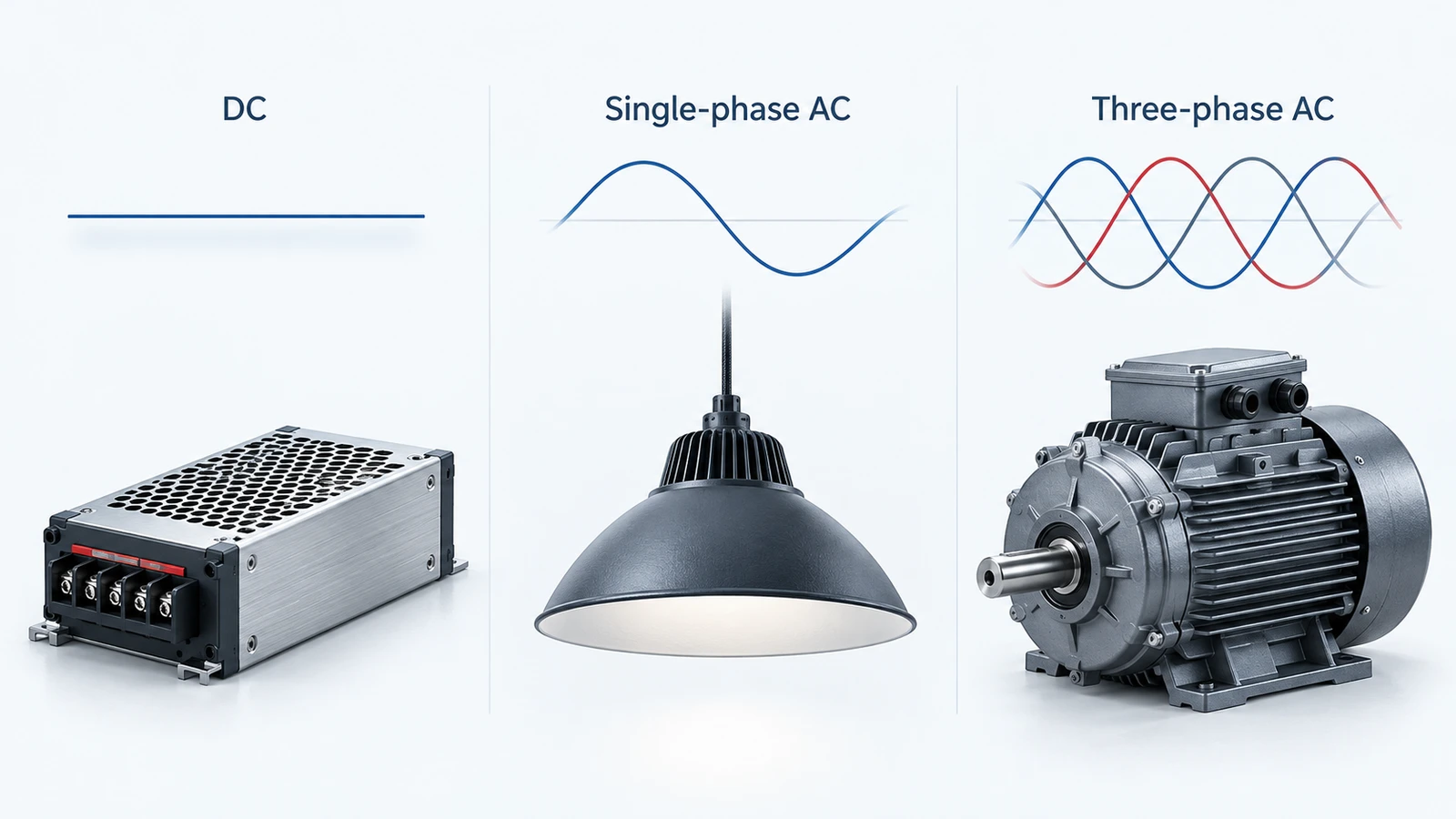
Example 1: a DC load
Assume a load receives 480 W of electrical input at a steady 48 V DC. Its calculated current is 480 / 48 = 10 A. This is an illustrative operating point, not a device recommendation.
If 480 W instead describes output from a converter, input current will be higher because the converter has losses. If voltage falls while a regulated load tries to maintain constant power, current can rise. Establish whether the figures describe the source, the converter input or the final load before comparing them.
Example 2: single-phase AC and power factor
Assume 2,000 W of real electrical input at 230 V with power factor 0.90. The estimated current is 2,000 / (230 × 0.90), approximately 9.66 A. Using 2,000 / 230 would give 8.70 A and omit the stated power factor.
A resistive load may be approximated at unity power factor for a suitable calculation. Do not apply that assumption automatically to motors, converters or a mixed group of loads. Where the current waveform is distorted, use true power factor and suitable RMS quantities rather than treating the phase angle alone as the complete answer.
Example 3: a balanced three-phase load
Assume a balanced load takes 15 kW of total real electrical input from a 400 V line-to-line supply at power factor 0.85. The line-current estimate is:
I = 15,000 / (1.732 × 400 × 0.85) ≈ 25.5 A.
The 15 kW is the total input to the three-phase load, not 15 kW per phase. Do not divide by three again after using the three-phase formula. Do not substitute a phase-to-neutral voltage into the line-to-line formula without changing the relationship.
Example 4: motor output and efficiency
Suppose 15 kW describes mechanical shaft output, with illustrative efficiency 0.92, power factor 0.85 and a 400 V three-phase supply. Current becomes 15,000 / (1.732 × 400 × 0.85 × 0.92), approximately 27.7 A.
The difference from the previous example comes from the assumed motor losses. These are separate worked examples, not performance claims for a particular motor. For an actual motor, use the nameplate and manufacturer data at the intended voltage and connection, then follow the applicable selection procedure.
What if the power is given in kVA?
Apparent power already includes the relationship between RMS voltage and current. For a single-phase load, I = S / V when S is in VA. For a balanced three-phase load, I = S / (√3 × VLL). Do not divide by power factor again when starting with apparent power.
For example, an illustrative balanced 30 kVA load at 400 V corresponds to about 43.3 A. That is a calculated current at the stated load, not a complete transformer or feeder sizing exercise. Future demand, load diversity, starting behavior and other design requirements remain separate questions.
Calculated current versus measured current
A calculation predicts current from a model. Measurement reports current at a particular operating condition. Neither should be presented without context. An unloaded motor, a cycling heater and a converter at full output can produce very different readings from the same equipment at another time.
For a real survey, record the supply, operating mode, loading, phase currents, instrument suitability and timing. An unbalanced three-phase installation needs phase-by-phase assessment; the balanced equation can hide the most heavily loaded conductor. Electrical measurement should follow the site’s safe-work procedures and be performed by appropriately competent personnel.
Turn the answer into a useful design input
- Write down whether power is electrical input, mechanical output or apparent power.
- State voltage, phases, power factor, efficiency and load balance assumptions.
- Keep normal operation separate from starting, transient and fault conditions.
- Use the result alongside the equipment data and applicable design rules.
For understanding how demand changes over time, see the electrical load factor guide. Average demand and maximum operating current answer different questions.
Common questions
Can watts alone tell me amperage?
No. You also need voltage and the relevant supply model. AC real-power calculations generally need power factor; mechanical-output calculations also need efficiency.
Can I choose the next larger breaker after calculating current?
Not from the calculation alone. Conductor protection, load characteristics, continuous duty, fault capability and local rules determine the selection.